 Skeinote
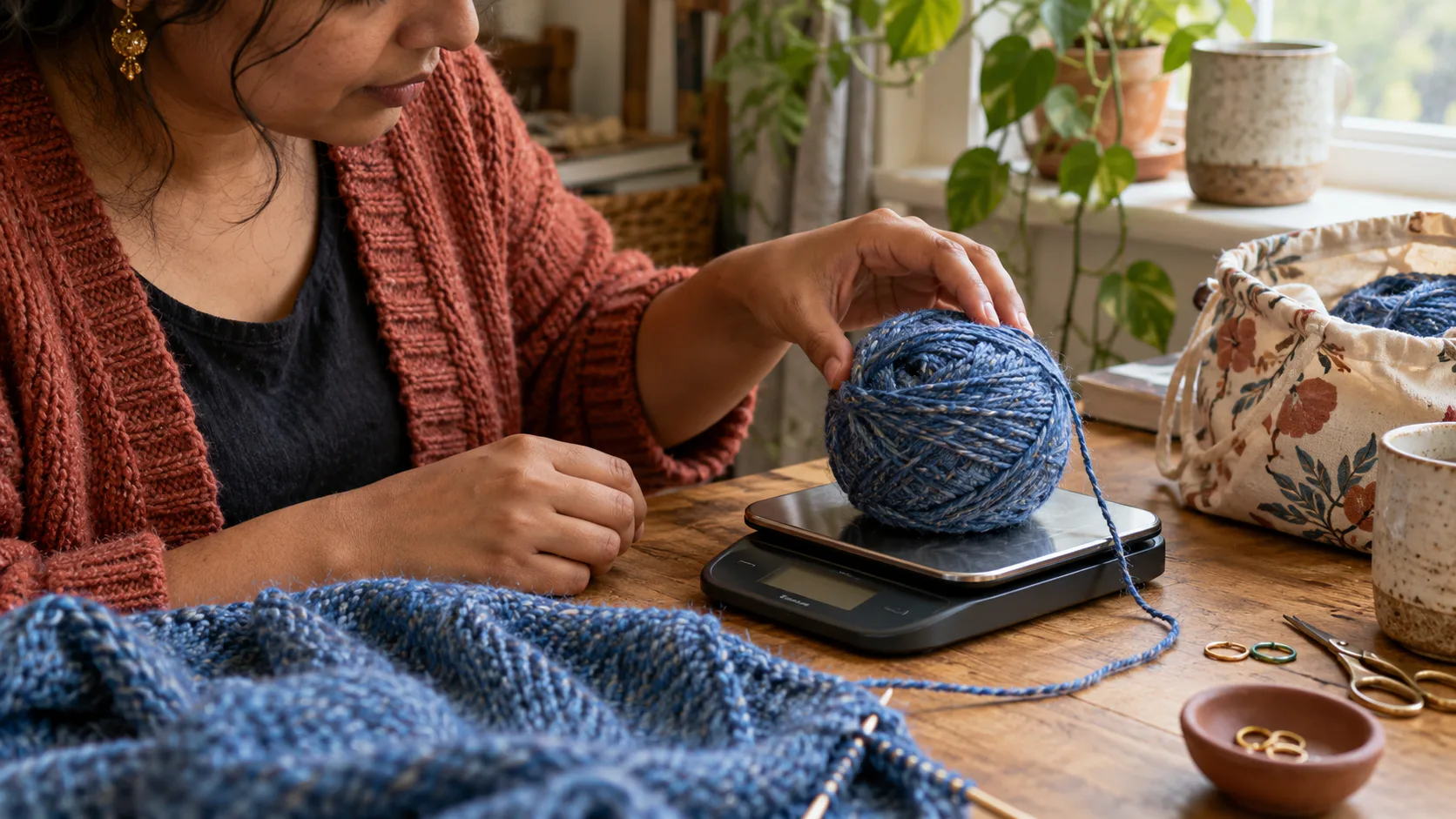
Weigh the partial ball, divide that weight by the maker's published package mass, then multiply by the published package length. For a 63 g ball of Cascade 220, using the maker's figures of approximately 220 yd per 100 g, the estimate is 138.6 yd:
remaining length = remaining mass ÷ published package mass × published package length
63 g ÷ 100 g × 220 yd = 138.6 yd
The result is an estimate based on two measurements: the maker's package figures and the weight shown by your scale. It is useful for deciding whether a leftover ball is worth considering for a project, but it is not a measurement of the yarn strand from end to end.
What you need before weighing
Find the exact maker and line name. Then note the mass and length published for one full package. Both figures must come from the same yarn line.
You will also need a scale that can display the unit you plan to use. Grams are convenient because many yarn makers publish package mass in grams, but ounces work when both the published figure and your measurement use ounces.
Remove anything that should not count as yarn, including the ball band. If the ball rolls or needs a container, put the empty container on the scale first and use the tare function so the display returns to zero. Then add the yarn and record the displayed weight.
Do not copy a ratio from a neighbouring yarn in the same family. Cascade 220, 220 Superwash Sport, and Cascade 220 Fingering have different package figures. The full line name is part of the calculation.
Work out the length per gram
Dividing the package length by the package mass produces a rate. Keep the unit attached to that rate: yd/g means yards per gram and m/g means metres per gram.
| Yarn line | Published package | Yards per gram | Metres per gram |
|---|---|---|---|
| Cascade 220 | 220 yd / 200 m per 100 g | 2.2 yd/g | 2 m/g |
| Malabrigo Rios | 210 yd / 192 m per 100 g | 2.1 yd/g | 1.92 m/g |
| Cascade Heritage | 437 yd / 400 m per 100 g | 4.37 yd/g | 4 m/g |
| Berroco Vintage | 218 yd / 199 m per 100 g | 2.18 yd/g | 1.99 m/g |
| Rowan Big Wool | 87 yd / 80 m per 100 g | 0.87 yd/g | 0.8 m/g |
These rates belong only to the named lines. They are calculated from the package figures shown on the linked maker pages, not from a general yarn-weight conversion.
For Malabrigo Rios, the maker publishes 210 yd and 192 m per 100 g. The two rates are:
210 yd ÷ 100 g = 2.1 yd/g
192 m ÷ 100 g = 1.92 m/g
Once you have the rate, multiply it by the weight of the partial ball. A 46 g remainder would give:
46 g × 2.1 yd/g = 96.6 yd
46 g × 1.92 m/g = 88.32 m
Keep the maker's yards route and metres route separate. Do not add yards to metres or grams to ounces as though they were the same unit.
Use the direct formula when you do not need the rate
You can put the whole calculation on one line:
remaining mass ÷ package mass × package length
Suppose a partial ball of Berroco Vintage weighs 72 g. Berroco publishes 218 yd and 199 m per 100 g. The estimates are:
72 g ÷ 100 g × 218 yd = 156.96 yd
72 g ÷ 100 g × 199 m = 143.28 m
The rate method and the direct formula are the same arithmetic. The rate is handy when you expect to weigh several leftovers of one line. The direct formula makes it easier to see which package figures were used for one calculation.
Combining partial balls of the same line
When several leftovers are the exact same yarn line, you can add their measured weights and calculate from the total. Three Cascade 220 leftovers weighing 18 g, 24 g, and 31 g have a combined mass of 73 g:
18 g + 24 g + 31 g = 73 g
73 g ÷ 100 g × 220 yd = 160.6 yd
Keep different lines separate even when their labels use the same weight category. Rowan publishes Big Wool at 80 m per 100 g and Felted Tweed at 175 m per 50 g. Combining their weights and applying one ratio would not describe either yarn correctly.
If the partial yarn is still attached to a project, weighing the project gives you the mass of the fabric, needles or hook, and any other material along with the remaining ball. This simple method needs the leftover yarn to be weighed on its own.
Why the exact line changes the answer
The words after a shared family name can point to a very different package. Cascade publishes 220 Superwash Sport at approximately 137 yd per 50 g, while Cascade 220 Fingering is approximately 273 yd per 50 g.
Their rates work out as follows:
220 Superwash Sport: 137 yd ÷ 50 g = 2.74 yd/g
Cascade 220 Fingering: 273 yd ÷ 50 g = 5.46 yd/g
A 30 g ball would therefore be estimated at 82.2 yd with the Sport figure and 163.8 yd with the Fingering figure. Guessing from the words “Cascade 220” would leave too much room for the wrong answer. Check the yarn catalogue for the complete line name and linked maker record.
Read the result as an estimate
Some maker pages label package length as approximate, and a scale reports weight at its available display resolution. Keep sensible decimal places while doing the arithmetic, then interpret the result with that uncertainty in mind.
If a project needs nearly every yard in your estimate, the calculation does not create extra yarn or guarantee that the ball will reach the final stitch. Joining tails, swatching, and other project use all come from the yarn you have. A close result deserves more margin or another ball.
The estimate is most useful when it gives a clear decision. If the calculated remainder is comfortably above a small project's requirement, you have a practical candidate. If it is below the requirement, set that ball aside for another use. If it is very close, treat the answer as a warning to plan conservatively.
For a purchase calculation using complete skeins, use the Skeinote calculator. It works from the selected lines' published package figures and keeps the arithmetic visible.