 Skeinote
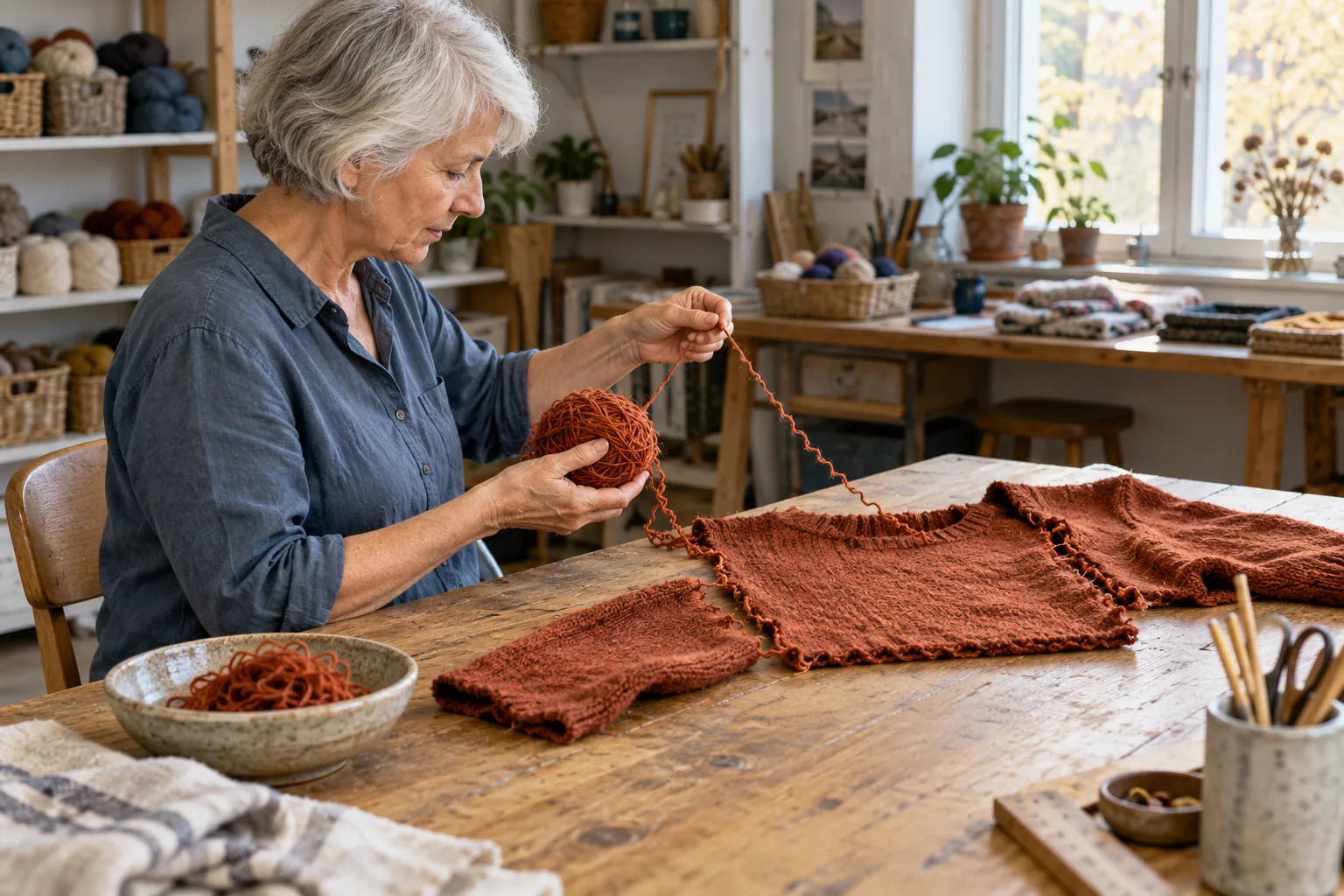
Often, yes. A sweater that was knitted in shaped pieces and then seamed can give you long, reusable lengths of yarn. One whose pieces were cut from a larger knitted fabric will unravel into short strands, so check the seams before you start. After that, the work is the same each time: unpick the seams, unravel each piece, rewind the yarn into hanks, wash out the kinks, and measure what you have before choosing a project.
Check the seams before you commit
Turn the sweater inside out and look at the seams where the sleeves, sides and shoulders join.
- Knitted-to-shape pieces. Tin Can Knits describes these as having no raw cut edge. A linked seam can look like a small column of Vs. Once unpicked, the pieces can usually provide long, usable lengths.
- Cut-and-sewn pieces. The edges are trimmed and wrapped in dense overlocking thread. The piece was cut out of a larger knitted fabric, which means every row was cut at the seam line. Unravelling it gives you strands only as long as one row.
A sweater can mix both: some are cut at the armholes and neckline but knitted to shape elsewhere. Check every seam, and treat any cut piece as a source of short lengths only.
Also check that the stitches are still distinct. If the fabric has matted so you cannot pick out individual stitches, the yarn will not pull free cleanly.
Take it apart
- Unpick the seams. Work from the inside, cutting or pulling out the seaming thread or yarn only. Tin Can Knits starts with the body sides and underarms, where a crochet-chain seam may unzip once you find the correct end.
- Find the end. Oregon State University Extension starts at the last stitch on the bound-off edge. Tin Can Knits notes that most bottom-up commercial jumpers need to be unravelled from the top of each piece, around the shoulder or neckline, working down.
- Unravel onto a ball or winder. Keep the tension light so you do not stretch the yarn.
- Keep each piece separate at first. If the sweater used more than one colour or yarn, label each ball.
Rewind into hanks
Knitter's Review describes rewinding the yarn into a hank as the first step in recycling old yarn, and advises winding under steady tension. A swift, a niddy-noddy or the back of a chair will do.
When the hank is wound, tie it loosely in a few places with scrap yarn so it does not tangle in the wash.
Expect the yarn to look crimped. Knitter's Review notes that yarn which spent any time as knitted fabric reverts to its kinky shape as soon as you pull it off the winder.
Wash out the kinks
Washing relaxes the yarn and shows you how it behaves before you invest hours in a new project. Knitter's Review points out that most abandoned yarn comes without a care label, so the wash is your chance to see whether it bleeds, disintegrates or felts.
Its method:
- Soak the hanks in a warm, gentle wash. The longer the fibres soak, the more they relax. It recommends at least five minutes before you rinse and squeeze.
- For wool, alpaca and other animal fibres, a dab of hair conditioner in the rinse can help revitalise them.
- Speed up drying with a short spin. Knitter's Review suggests spinning wet hanks in a washing machine for 20 to 30 seconds, rotating them and repeating if they are very wet.
- Let them dry. If the hanks soaked long enough, the kinks should already be gone. Knitter's Review notes that hanging weights on wool hanks is misleading, because the bounce returns at the next wash.
Two cautions from the same source. Protein fibres such as wool and alpaca become weaker as soon as they are wet, and steaming stretched protein fibres then keeping them under tension can leave them permanently stretched. And it is never a good idea to wind damp yarn into a ball, especially yarn that may contain cotton or other plant fibres. Let the hanks dry fully first.
Work out what you have
A reclaimed yarn has no ball band, so you need to measure its weight category and its length yourself.
Weight category
Once the yarn is dry, measure its wraps per inch: wrap it snugly around a pencil for a few inches and count the wraps in one inch. The Craft Yarn Council's chart turns that count into an approximate category, though its ranges overlap, so one count can fit two or three categories. The wraps per inch guide gives the full chart and method.
Length
You cannot borrow a length from a similar yarn, because yarns of the same category hold different lengths for the same weight. Measure your own:
- Measure out a long sample, say 20 yd.
- Weigh the sample, then weigh all the remaining yarn.
- Divide the remaining weight by the sample's weight and multiply by the sample length.
For example, if a 20 yd sample weighs 8 g and the rest of the reclaimed yarn weighs 410 g:
410 g ÷ 8 g × 20 yd = 1,025 yd
1,025 yd + 20 yd sample = 1,045 yd in total
A scale that reads to the nearest gram makes a small sample uncertain. The WPI guide shows how far that rounding can move the answer, and why the lower figure is the safe one to plan with.
Choose the project to fit the yarn
With an approximate category and a measured length, compare the reclaimed yarn with a pattern exactly as you would any other yarn:
- The pattern's total length should be comfortably below your measured length, because joins between pieces use extra yarn and you cannot buy more of the same.
- Swatch first. Washed reclaimed yarn can behave differently from its old fabric, and the swatch settles which of the overlapping categories it acts like. The gauge swatch guide explains how to wash and measure it.
- If you are short, plan a contrast colour or stripe from the start. The dye-lot guide has techniques for blending a second yarn into a piece.