 Skeinote
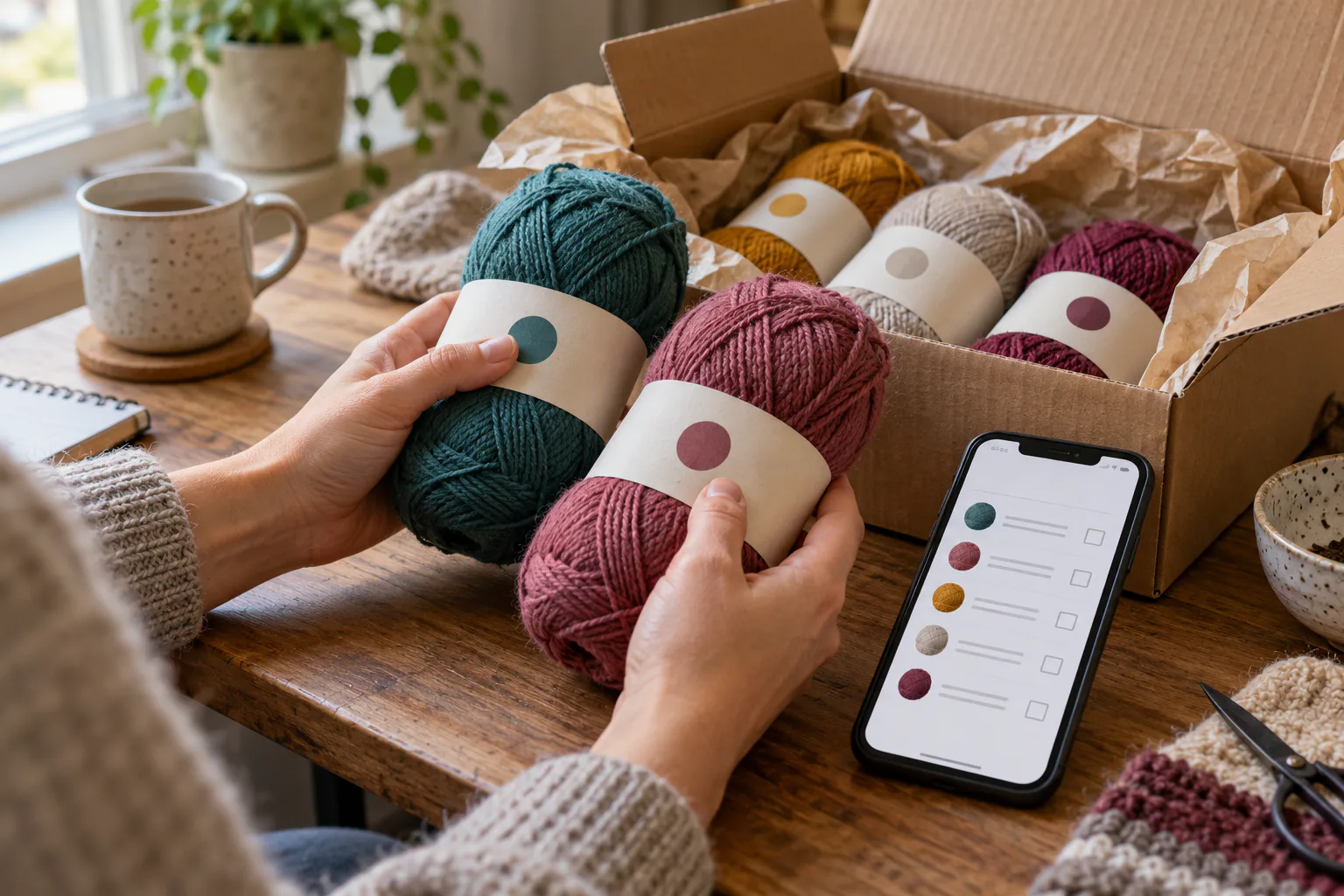
Before you order yarn online, check five things on the product page and in the store's policies: the exact line the pattern needs, the length per skein, the gauge, fibre and care details, enough skeins to finish in one dye lot, and the store's return terms. You cannot squeeze or compare the yarn before it arrives, so the product page has to do the work your hands would do in a shop.
1. Identify the exact line, not just the brand
Many yarns share a family name with several variants. Cascade sells Cascade 220 and Cascade 220 Fingering, for example, and they are different products with different package lengths. A listing headed with the family name alone is not enough.
Before adding anything to the basket:
- Match the full line name the pattern gives, including words such as Fingering, Superwash, Sport or Chunky.
- Check the colour name or number if the pattern photograph is the look you want.
- If the pattern yarn is no longer sold, use the discontinued-yarn guide to choose a replacement before you shop.
Our guide to solid and print versions of the same family shows why two listings with nearly identical names can still differ in length.
2. Read the published package figures
A useful product page states the length and weight of one package. Two published examples:
| Line | Length per package | Package weight | Published care |
|---|---|---|---|
| Berroco Vintage | 218 yd / 199 m | 3.5 oz / 100 g | Machine wash inside out in cold water, gentle cycle; lay flat to dry |
| Cascade 220 Fingering | 273 yd (250 m) | 50 g (1.75 oz) | Hand wash cold; lay flat to dry |
If the listing omits the length, find the maker's own product page before ordering. Without a length per package, you have nothing to divide the pattern's requirement by.
3. Work out the total before you choose a quantity
Order by length, not by a guess at the number of balls:
skeins to order = pattern's total length ÷ length per skein, rounded up
Suppose a pattern needs 1,000 yd and you choose Berroco Vintage:
1,000 yd ÷ 218 yd = 4.59 skeins, so order 5
If the pattern states its requirement in skeins of a different yarn, convert it to total yards or metres first. The skeins guide shows the full conversion, and the Skeinote calculator runs it with published figures for exact lines in the catalogue.
4. Compare gauge, fibre and care to the pattern
The weight category is a starting filter. Online, the published details are your only way to judge the fabric before it arrives:
- Gauge. Berroco publishes two knitting gauges for Vintage: 20 stitches and 27 rows over 4 inches on US 7 (4.5 mm), and 18 stitches and 24 rows over 4 inches on US 8 (5 mm). Compare the listed gauge with your pattern's gauge.
- Category. Berroco lists Vintage as
4 - Worsted; Hobbii lists Fluffy Day asMedium. The yarn weight numbers guide explains how these categories relate. - Fibre. Vintage is published as 52% acrylic, 40% wool and 8% nylon; Fluffy Day as 100% acrylic. Two medium yarns can feel and behave very differently.
- Care. Decide whether the finished item needs to go in a washing machine. Compare the two care lines in the table above.
None of these replaces a swatch, but each one can rule a yarn out before you pay for it. The label guide explains each field in more detail.
5. Order the whole amount together, then check the dye lots
A dye lot is the batch the yarn was dyed in. Lion Brand explains that yarn from one batch is the same colour and carries the same dye lot number on the label, while two different lots can look the same under some light and very different under other light.
Lion Brand also says it is not able to match dye lots. Yarn is packed in cartons by dye lot and shipped to stores, and before long that lot sells out. That is why its labels say to buy everything you need from one dye lot at one time.
For an online order, that means:
- Order the full quantity together, including any margin you want, rather than planning a second order later.
- Check the dye lot numbers on delivery. Before winding anything, compare the numbers on every label.
- Compare colours in daylight if any labels differ, since different lots can look alike under one light and not another.
If you run short anyway, the dye-lot guide covers how to work a second lot into a project.
6. Read the return terms before you pay
Return policies vary from store to store, and the details matter for yarn. As one example, Furls' published policy allows a return for refund up to 90 days after purchase, but all yarn must be returned in its original packaging and in the form in which it was bought.
Check, for the store you are using:
- How long you have to return unused yarn.
- Whether winding a skein into a ball or cake, or removing the band, ends your right to return it.
- Whether the refund includes the original shipping cost.
- Whether digital patterns are returnable. Brooklyn Tweed, for example, sells pattern PDFs as final sales that are neither returnable nor refundable.
If you plan to swatch before committing to the whole project, one approach is to wind and swatch from a single skein and keep the rest unopened until the swatch confirms the yarn.
A one-minute checklist
Before you press the order button:
- The full line name and colour match what you intend to use.
- The listing, or the maker's page, gives length per package.
- You have calculated the total and rounded up to whole skeins.
- The published gauge, fibre and care suit the pattern and the finished item.
- You are ordering the full amount in one order.
- You know the store's return window and condition rules.
When the box arrives, check the dye lot numbers, look at the colour in daylight, then swatch before you wind the rest.