 Skeinote
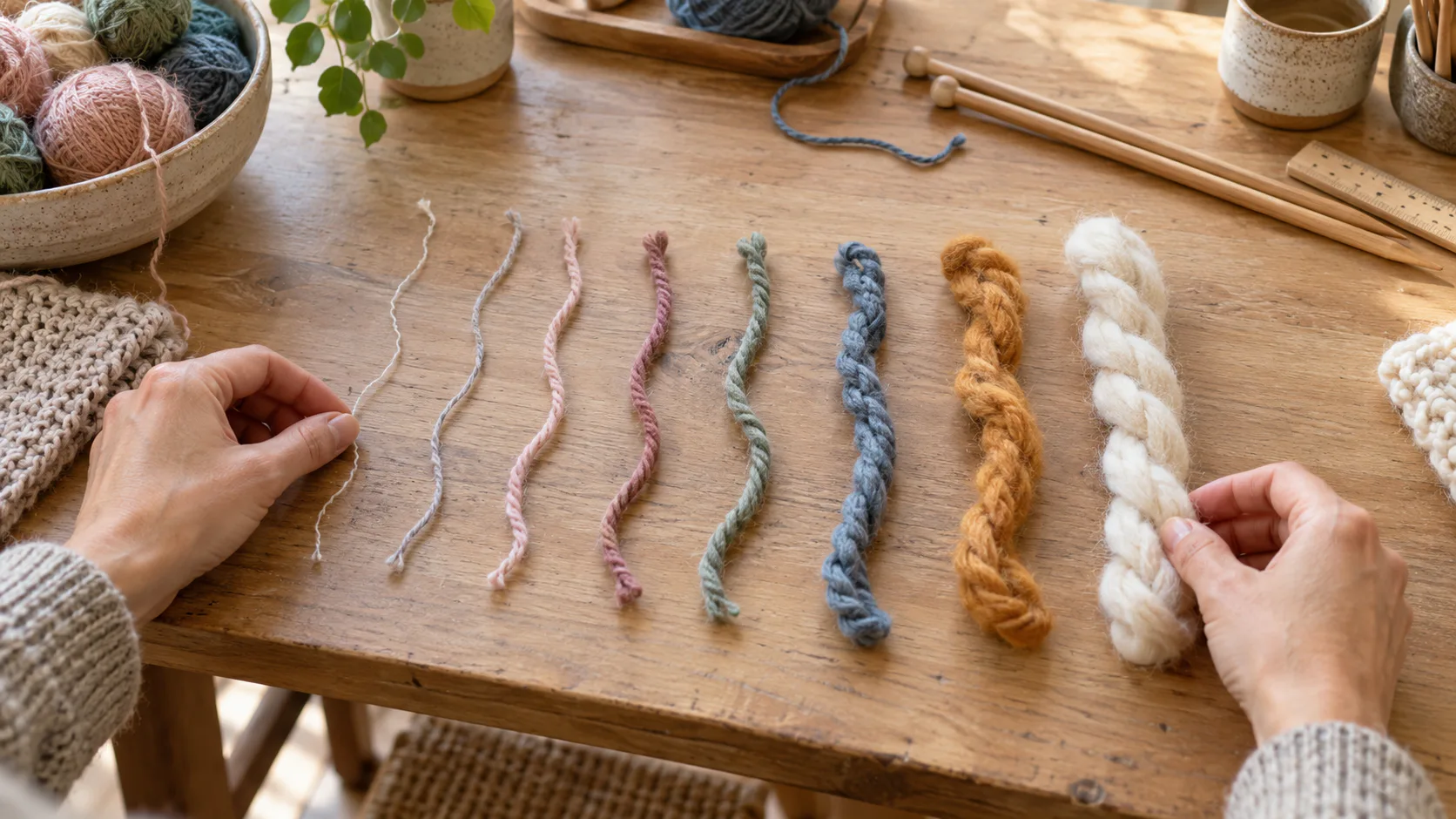
The number inside the yarn-ball symbol tells you the yarn's standard weight category, which is a range of thicknesses. The system runs from 0 Lace to 7 Jumbo. It gives you a quick way to narrow the field when reading a pattern or shopping for yarn.
That number is a starting point. Your pattern's gauge, the yarn's fiber, the length in each package and the fabric you make still determine whether a particular yarn suits the project.
The eight yarn weight numbers
The Craft Yarn Council publishes eight categories. Its needle and hook ranges are guidelines for commonly used gauges, so a pattern can legitimately call for a tool outside the range.
| Number | Standard category | Other common terms | Typical knitting needle range | Typical crochet hook range |
|---|---|---|---|---|
| 0 | Lace | Thread, cobweb, lace | US 000 to 1 (1.5 to 2.25 mm) | Steel hooks are commonly used |
| 1 | Super Fine | Fingering, sock, baby | US 1 to 3 (2.25 to 3.25 mm) | B-1 to E-4 (2.25 to 3.5 mm) |
| 2 | Fine | Sport, baby | US 3 to 5 (3.25 to 3.75 mm) | E-4 to 7 (3.5 to 4.5 mm) |
| 3 | Light | DK, light worsted | US 5 to 7 (3.75 to 4.5 mm) | 7 to I-9 (4.5 to 5.5 mm) |
| 4 | Medium | Worsted, afghan, aran | US 7 to 9 (4.5 to 5.5 mm) | I-9 to K-10 1/2 (5.5 to 6.5 mm) |
| 5 | Bulky | Chunky, craft, rug | US 9 to 11 (5.5 to 8 mm) | K-10 1/2 to M-13 (6.5 to 9 mm) |
| 6 | Super Bulky | Super bulky, roving | US 11 to 17 (8 to 12.75 mm) | M-13 to Q (9 to 15 mm) |
| 7 | Jumbo | Jumbo, roving | US 17 and larger (12.75 mm and larger) | 15 mm and larger |
Category 0 needs a little context. Lace yarn is often worked on larger needles or hooks to create an open fabric, so the pattern's stated gauge matters more than a general tool range. Category 7 can include arm-knitting projects as well as projects made with very large tools.
Yarn weight is thickness, not package mass
The word “weight” causes a predictable mix-up. A yarn weight number classifies thickness. A package statement such as 100 g or 3.5 oz tells you the physical mass of that ball or skein.
Two packages can both weigh 100 g while holding very different lengths. A fine yarn fits much more strand into that mass than a thick yarn does. This is why a pattern requirement stated in yards or metres cannot be replaced by matching package weight alone.
When you read a label, keep these fields separate:
- The number and category name describe a thickness range.
- The yards or metres tell you the length in one package.
- The grams or ounces tell you the package mass.
- The gauge box shows the maker's suggested fabric measurement and tool size.
- Fiber content and care instructions tell you what the yarn is made from and how the finished item should be handled.
Our guide to reading a yarn label walks through those fields together.
What the category number is good for
Suppose a pattern asks for category 4 Medium yarn. You can begin by looking at yarns marked 4 instead of comparing every line in the shop. The number has done its job by creating a sensible shortlist.
Next, compare the pattern with each candidate:
- Does the label's suggested gauge sit near the pattern gauge?
- Does the yarn have enough total length for the size you plan to make?
- Will the fiber and care instructions suit the finished item?
- Does a swatch produce the fabric and measurements you want?
The category narrows the search. The answers to those questions make the decision.
Why yarns with the same number still differ
A category contains a range rather than one exact diameter or one fixed yards-per-gram rate. Cascade 220 Fingering and Knit Picks Palette are both sold as fingering-weight yarns, yet their makers publish different package lengths for the same 50 g package mass. The category places both in the same broad thickness family. It does not make their packages interchangeable.
The finished fabric can differ too. Fiber blend, construction and the way you work the stitches all affect the swatch. Our same-category comparison guide shows why the shared label is not the end of the substitution check.
How to use the number for a substitution
Start with the category named by the pattern. If the pattern names a specific yarn, record that yarn's category, fiber content, published gauge and total required length before looking for another line.
Then follow a short sequence:
- Filter by category. Look for candidates in the requested number or the precise range allowed by the pattern designer.
- Compare the gauge information. Treat the label gauge as a screening clue. The project gauge in the pattern remains the target.
- Compare fiber and care. A shared number does not promise the same drape, elasticity, texture or washing method.
- Compare total length. Add the yards or metres required by the pattern, then divide by the candidate yarn's package length.
- Make and finish a swatch. Work the pattern stitch, care for the swatch as the finished project will be cared for, and measure the resulting fabric.
If the original line is gone, the guide to replacing a discontinued pattern yarn covers the full comparison.
Use the package length for the buying calculation
Once you have chosen a candidate, calculate packages from length rather than from the category number. For example, Berroco publishes Vintage at 218 yd per 100 g. A project requiring 1,000 yd would use this package calculation:
1,000 yd ÷ 218 yd per skein = 4.59 skeins
round upward to 5 whole skeins
The arithmetic applies to that exact yarn line and package figure. Select a different line and the divisor changes. The Skeinote calculator performs this division with the maker figures stored in the catalogue.
When the number is missing
Some labels use a familiar term such as DK or worsted without displaying the numbered symbol. A maker's product page may provide the category, suggested gauge or tool range. If the label is missing entirely, wraps per inch can help you make a preliminary thickness estimate, followed by a swatch.
Do not assign an exact yarn identity from appearance alone. Several lines can look alike while differing in fiber, construction and length per package. If you need a buying calculation, identify the exact line or measure the yarn directly instead of borrowing another yarn's package ratio.
The quickest useful reading of the symbol is simple: 0 is the finest category, 7 is the thickest, and every number describes a range. Use it to find candidates, then let the pattern, label, total length and finished swatch make the final call.