 Skeinote
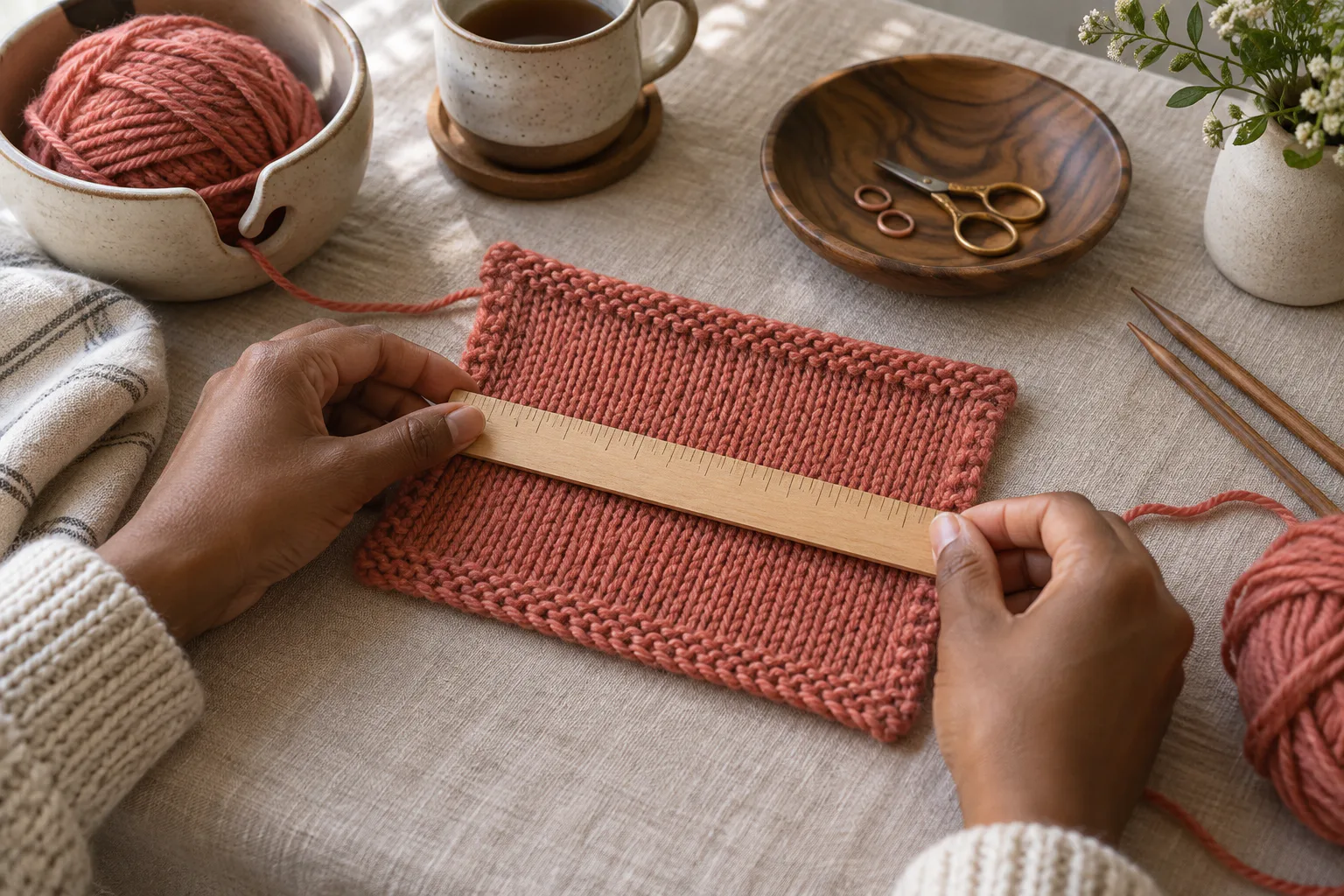
Not necessarily. Worsted, DK, or another shared category is a starting filter, not a fabric guarantee. For the same 1,100-yard requirement, Cascade 220 needs five 220-yard hanks, Malabrigo Rios needs six 210-yard skeins, and Berroco Vintage needs six 218-yard hanks. Their published gauge and fiber details still differ.
| Exact line | Maker wording | Length | Skeins for 1,100 yd | Published knitting gauge | Published fiber |
|---|---|---|---|---|---|
| Cascade 220 | worsted-weight hank | 220 yd | 5 | 18 - 20 sts = 4 in | 100% Peruvian Highland Wool |
| Malabrigo Rios | Worsted | 210 yd | 6 | 18.0 to 22.0 sts = 4 in | 100% Superwash Merino Wool |
| Berroco Vintage | 4 - Worsted | 218 yd | 6 | 18 or 20 sts = 4 in across two rows | 52% acrylic, 40% wool, 8% nylon |
The table shows why there are two decisions. Published length produces the purchase count. The remaining columns tell you what the count has not settled. Calculate the whole-skein quantity, then use the fabric checks below.
Category is the first filter
A maker's category describes an exact line broadly enough to catch obvious mismatches. Berroco publishes Vintage as 4 - Worsted and Vintage DK as 3 - DK. When both selected records carry clearly different numeric categories, Skeinote stops rather than present the division result as a routine buying answer.
Not every maker uses the same label format. Cascade calls Cascade 220 a worsted-weight hank. Malabrigo lists Rios as Worsted. Some pages provide a product name and gauge without a formal category number. Skeinote keeps the printed wording instead of translating every page into its own universal system.
That makes the category comparison deliberately narrow. It can identify a documented difference or show the wording side by side. It cannot certify the resulting fabric.
Package length changes the purchase count
The three lines in the opening table all use worsted wording, yet their package lengths are 220, 210, and 218 yards. For 1,100 yards:
Cascade 220: 1,100 ÷ 220 = 5.00, so 5 hanks
Malabrigo Rios: 1,100 ÷ 210 = 5.24, so 6 skeins
Berroco Vintage: 1,100 ÷ 218 = 5.05, so 6 hanks
Buying the same number of packages would leave the Rios total short. The count comes from exact-line yardage, not the shared category. Read how many skeins of a different yarn do I need? for the complete calculation.
Published gauge narrows the question
Cascade publishes 18 to 20 stitches over 4 inches for Cascade 220. Malabrigo publishes 18 to 22 for Rios. Berroco publishes two Vintage rows, one at 20 stitches and one at 18 stitches over 4 inches.
Those ranges provide useful context, but the project still introduces variables the maker page cannot observe: the chosen needle or hook, your tension, the stitch pattern, and how the swatch is treated. Even one exact line can produce different fabrics across that range.
Record the pattern gauge and the maker's range, then make a swatch in the actual stitch pattern. Measure it after treating it the way you intend to treat the finished item. If the gauge or fabric misses the project, the quantity calculation remains mathematically traceable, but the target yarn is not ready for a large purchase.
Fiber and care can change the result you feel
The makers describe three different materials:
- Cascade 220: 100% Peruvian Highland Wool.
- Malabrigo Rios: 100% Superwash Merino Wool.
- Berroco Vintage: 52% acrylic, 40% wool, and 8% nylon.
Fiber wording is not a score, and Skeinote does not turn it into one. It is a direct reason to inspect the swatch for the qualities that matter to your project and to follow the target yarn's care instructions.
The distinction matters even when gauge overlaps. Two swatches can reach the same stitch count and still differ in feel, drape, stitch definition, or behavior after care. That is why the calculator keeps fiber and gauge visible beside the number instead of hiding them behind a compatible badge.
What happens when categories differ
Malabrigo publishes Mecha as Bulky with 130 yards per 100 g skein. Cascade publishes Heritage as fingering weight with 437 yards per 100 g skein. Dividing a Heritage requirement by Mecha's package length would still produce a number, but the makers' categories describe a clear mismatch.
Skeinote withholds the count in that state. An experienced knitter or crocheter may deliberately redesign a project, but that is a different job from calculating a straightforward replacement quantity.
Before choosing a target, read each yarn-label field separately. When the categories are plausibly aligned, use published length for the count and let the swatch answer the fabric question.