 Skeinote
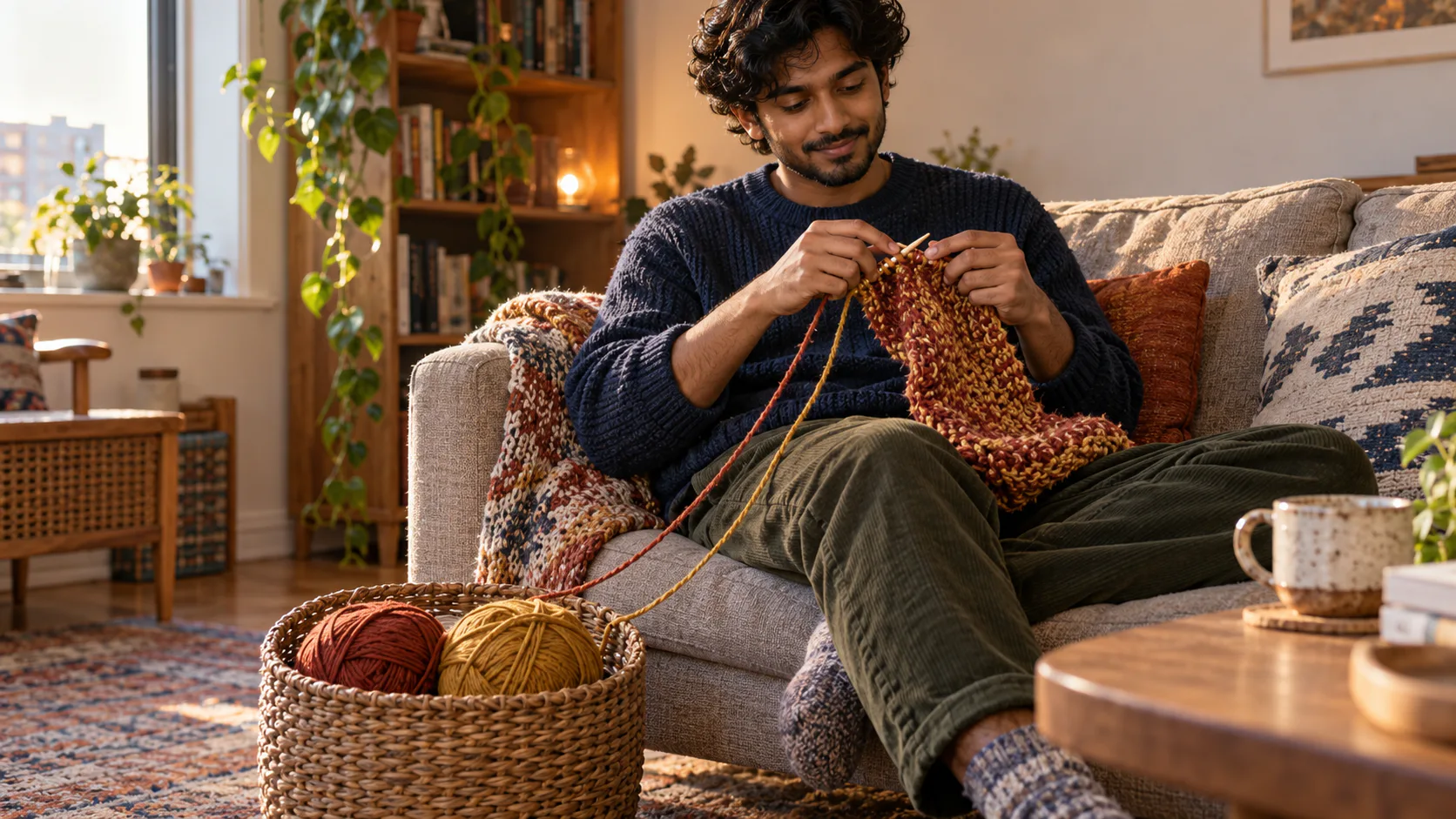
Two strands of a finer yarn held together work up approximately like one strand of a thicker yarn. Lion Brand's support team gives three common pairings: two strands of fingering for one of sport weight, two of sport for one of worsted, and two of worsted for one of chunky to super bulky. These are approximate equivalents, so swatch before you commit. Plan on twice the pattern's yardage of the finer yarn when the doubled strand matches the pattern gauge.
What two strands make
Lion Brand states that you may use two strands of a finer weight held together to approximate the gauge of a thicker yarn, and lists these approximate equivalents:
| Hold together | Approximately equals |
|---|---|
| 2 strands fingering | 1 strand sport weight |
| 2 strands sport | 1 strand worsted weight |
| 2 strands worsted | 1 strand chunky to super bulky |
The last row is a range for a reason. Lion Brand notes that two strands of a lighter worsted, giving Wool-Ease and Fishermen's Wool as examples, may approximate a chunky yarn, while two strands of a heavier worsted such as Vanna's Choice may approximate a super bulky yarn. Yarns that share a category name can still differ in thickness, and doubling them doubles that difference.
If you are not sure where your starting yarn sits, the yarn weight numbers guide explains the categories, and the wraps per inch guide shows how to estimate the category of unlabelled yarn.
Why the equivalent is only approximate
Lion Brand's own wording is "approximate equivalents", with the reminder to check that you are obtaining gauge, as with all substitutions. The doubled strand is two separate plies lying side by side rather than one spun yarn, so its thickness, texture and drape will not match a single strand exactly.
That makes the swatch the deciding step:
- Hold your two strands together and work a swatch in the pattern's stitch on the suggested needle or hook.
- Measure the stitches and rows against the pattern gauge.
- Change tool size until the stitch gauge matches, then judge whether you like the fabric.
The same-category guide covers why a swatch, rather than a category name, decides whether a fabric works.
How much yarn to buy
Every inch of a doubled strand uses an inch of each yarn. So once your doubled strand matches the pattern gauge, it consumes roughly the length of the pattern yarn, and you need twice that length of the finer yarn in total.
Total length of finer yarn = 2 × pattern yardage
Skeins to buy = total length ÷ length per skein, rounded up
The doubling assumes your swatch matches the pattern gauge. If you knit the doubled strand at a different gauge, the yardage changes too, so settle the gauge first.
Example: two strands of fingering for a sport-weight pattern
A pattern calls for 900 yd of sport-weight yarn. You plan to hold two strands of Cascade 220 Fingering, which Cascade publishes at 273 yd (250 m) per 50 g hank:
2 × 900 yd = 1,800 yd of Cascade 220 Fingering
1,800 yd ÷ 273 yd per hank = 6.59 hanks
round up to 7 hanks
You do not need an even number of hanks. When one strand's ball runs out, you join a fresh one, and the remainder of a part-used hank can supply the other strand. The total length is what matters.
Example: two strands of worsted for a chunky pattern
A pattern calls for 500 m of chunky yarn. You plan to double Rowan Pure Wool Superwash Worsted, which Rowan publishes at 200 m (218 yd) per 100 g ball:
2 × 500 m = 1,000 m of Pure Wool Superwash Worsted
1,000 m ÷ 200 m per ball = 5.00 balls
Five balls exactly covers the doubled requirement with nothing spare. Any yarn used for the swatch, or a gauge slightly looser than the pattern's, comes out of that total, so decide whether you are comfortable with no margin before buying the exact figure.
Keep the units consistent: this example works in metres throughout because both the pattern requirement and the maker's figure are given in metres. To convert a requirement between yards, metres and skeins, see how many skeins of a different yarn you need.
Doubling two different yarns
You can also hold two different yarns together, such as a wool with a mohair. The same length logic applies: the doubled strand uses the pattern length of each yarn. Work out each yarn separately, divide by that yarn's own length per skein, and round each up to whole skeins. Do not combine the two packages into one figure, because their lengths per skein differ.
Lion Brand's equivalents describe two strands of the same weight. For a mixed pair, the swatch is the only reliable guide to the resulting gauge.
When to use the calculator instead
The Skeinote calculator compares one strand of the pattern's yarn with one strand of a replacement line. It deliberately withholds a skein count when the two makers list different weight categories, so it will not do the doubled-strand arithmetic for you. Use the two-line calculation above for a doubled strand, and the calculator when you are swapping like for like.