 Skeinote
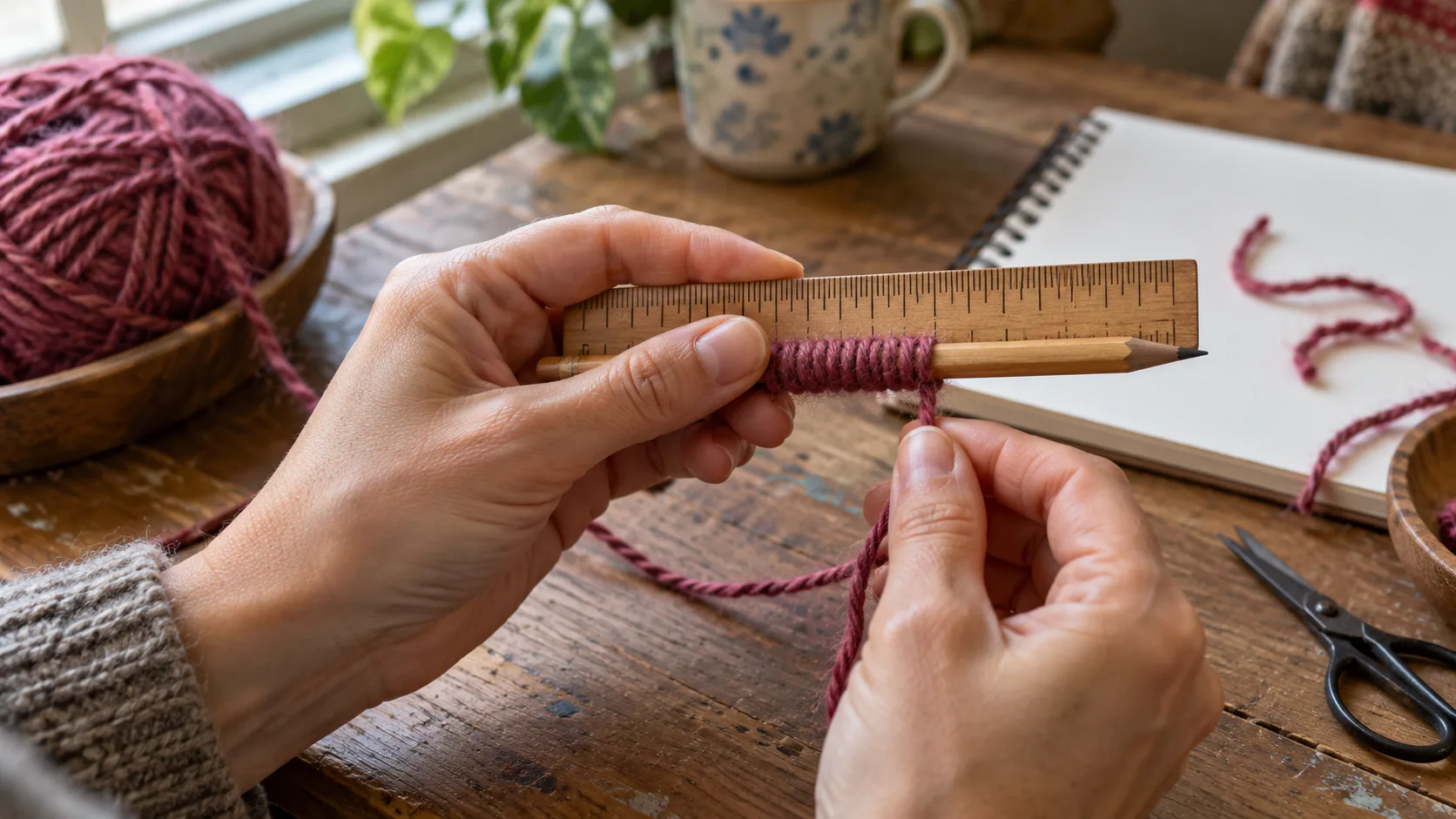
To measure wraps per inch (WPI), wrap the yarn snugly around a pencil for a few inches, with each turn lying beside the last, then count how many wraps sit in one inch of the ruler. Compare that count with the Craft Yarn Council chart below. The result places unlabelled yarn in an approximate weight category, and often in more than one, so finish with a swatch before you commit to a pattern.
WPI is a thickness check. It cannot tell you how many yards are in the ball, and it cannot identify the exact yarn line. Both points matter later in this guide.
What you need
The Craft Yarn Council's method needs only a ruler and something with a consistent circumference to wrap the yarn around, such as a pencil. A dedicated WPI tool does the same job: Knit Picks describes holding the tool, sliding the yarn tail through the slit at the top, then guiding the yarn around the handle.
Wrap and count, step by step
- Wrap a few inches. Start winding the yarn around the pencil and keep going for a few inches rather than stopping at exactly one.
- Keep the turns snug and side by side. The Craft Yarn Council asks for wraps that lie next to each other without overlapping and without large gaps. Do not pull hard: stretching the yarn thins it and pushes the count up.
- Count the wraps in one inch. Hold the ruler against the wraps and count the turns that sit inside one inch.
- Check a few places. Count a different inch along the wraps, much as you would measure a gauge swatch in more than one spot. If the counts disagree, rewrap and look at your tension.
If you are not sure your tension is right, practise first on a yarn you already know the weight of. A labelled ball from your stash makes a useful reference: if your count for it lands in its labelled category, your wrapping is in a sensible range.
Fuzzy, bumpy and very fine yarns
Mohair, bouclé and other textured yarns do not sit in a neat row. For these, Knit Picks suggests leaving space between the wraps and continuing to the 2 or 3 inch mark. Count every wrap, then divide by the number of inches you covered.
For example, if a bouclé covers 2 inches with 17 wraps, the count is 17 ÷ 2 = 8.5 wraps per inch. That small calculation stops one lumpy inch from dominating the result.
Read your count against the chart
The Craft Yarn Council publishes these WPI ranges for its standard yarn weight categories:
| Category | WPI range |
|---|---|
| 0 Lace | 30-40+ |
| 1 Super Fine | 14-30 |
| 2 Fine | 12-18 |
| 3 Light | 11-15 |
| 4 Medium | 9-12 |
| 5 Bulky | 6-9 |
| 6 Super Bulky | 5-6 |
| 7 Jumbo | 1-4 |
The council says the chart is based on WPI information shared by industry experts and two published WPI lists, and it calls WPI subjective. Read it as a set of overlapping bands rather than a lookup table with one answer per count.
Many counts fit more than one category
The ranges overlap, so a single count can belong to two or three categories:
| Your count | Categories whose published range includes it |
|---|---|
| 30 WPI | 0 Lace (30-40+) and 1 Super Fine (14-30) |
| 14 WPI | 1 Super Fine (14-30), 2 Fine (12-18) and 3 Light (11-15) |
| 12 WPI | 2 Fine (12-18), 3 Light (11-15) and 4 Medium (9-12) |
| 9 WPI | 4 Medium (9-12) and 5 Bulky (6-9) |
| 6 WPI | 5 Bulky (6-9) and 6 Super Bulky (5-6) |
A count of 12 does not tell you whether you have sport, DK or worsted yarn. It tells you the yarn probably sits somewhere in that neighbourhood. Counts in the middle of a band, such as 10 or 16, point more clearly at one or two categories, but the council's own advice still applies: work up a gauge swatch before starting a project.
The yarn weight numbers guide explains what each category means and the needle and hook ranges the council publishes for them.
Why two people get different counts
The Craft Yarn Council notes that results vary with how tightly the yarn is wrapped. SweetGeorgia Yarns lists further reasons a count varies: how tightly the yarn is wound, how much length is wound, and how closely the wraps are packed. It also notes that unfinished handspun yarn typically blooms when washed, which makes it thicker and lowers its WPI.
Two practical consequences follow:
- Record how you measured. Write down the count, the object you wrapped around, and whether you wrapped one inch or several. A later re-measurement is only comparable if you used the same method.
- Use the right chart for handspun. SweetGeorgia's own WPI chart gives rough targets for singles spun to be plied. Spinners working towards a finished yarn should not read that chart as the commercial category table above.
What WPI cannot tell you: the length of the ball
It is tempting to measure the WPI, decide the yarn is worsted, look up a worsted yarn's yards per gram, and multiply by the weight of the mystery ball. That gives a number, but not a trustworthy one.
A category is a range of thicknesses, and yarns inside it hold different lengths for the same package weight. Two medium-weight lines in the Skeinote catalogue show how far apart they can sit:
| Yarn line | Maker's weight label | Published package |
|---|---|---|
| Berroco Vintage | 4 - Worsted | 218 yd per 100 g |
| Hobbii Fluffy Day | Medium | 311.68 yd (285 m) per 100 g |
Borrow each ratio for the same 64 g mystery ball and the answers are far apart:
Berroco Vintage:   64 g ÷ 100 g × 218 yd    = 139.5 yd
Hobbii Fluffy Day: 64 g ÷ 100 g × 311.68 yd = 199.5 yd
A WPI count in the medium range cannot tell you which of those, if either, describes your ball. Borrowing another line's ratio estimates a different yarn, not yours. The same-category comparison covers the other ways two yarns with one label differ.
Measure your own yarn's length per gram instead
If you need the length of an unlabelled ball, take the ratio from the yarn itself:
- Measure out a long sample with a tape measure. The longer the sample, the less a scale's rounding matters.
- Weigh the sample, then weigh the rest of the ball.
- Divide the ball's weight by the sample's weight, then multiply by the sample length.
Suppose a 20 yd sample weighs 9 g on a scale that shows whole grams, and the rest of the ball weighs 64 g:
64 g ÷ 9 g × 20 yd = 142.2 yd
Now allow for the scale. A reading of 9 g on a whole-gram display could be anywhere from 8.5 g to 9.5 g:
64 g ÷ 9.5 g × 20 yd = 134.7 yd
64 g ÷ 8.5 g × 20 yd = 150.6 yd
That 16 yd spread comes from rounding the sample weight alone, before counting any error in the ball's own reading. Measure a longer sample, or use a scale with finer resolution, and the spread narrows. Then treat the lower figure as the safe planning number.
When the ball is a known line with a published package mass and length, use the maker's figures instead. The partial-ball guide walks through that calculation.
Putting it together for a project
With an approximate category and a measured length, you can make a sensible decision about unlabelled yarn:
- Shortlist patterns that call for the category, or categories, your count supports.
- Compare length. Check the pattern's total yards or metres against your measured length, using the lower end of your estimate.
- Swatch. Knit or crochet a swatch at the pattern gauge and compare the fabric. This is the step that settles which of the overlapping categories the yarn behaves like.
If you later find the yarn's label or identify the exact line, switch to the maker's published figures. The Skeinote calculator uses those for its package arithmetic, and the guide to reading a yarn label shows where to find each figure.