 Skeinote
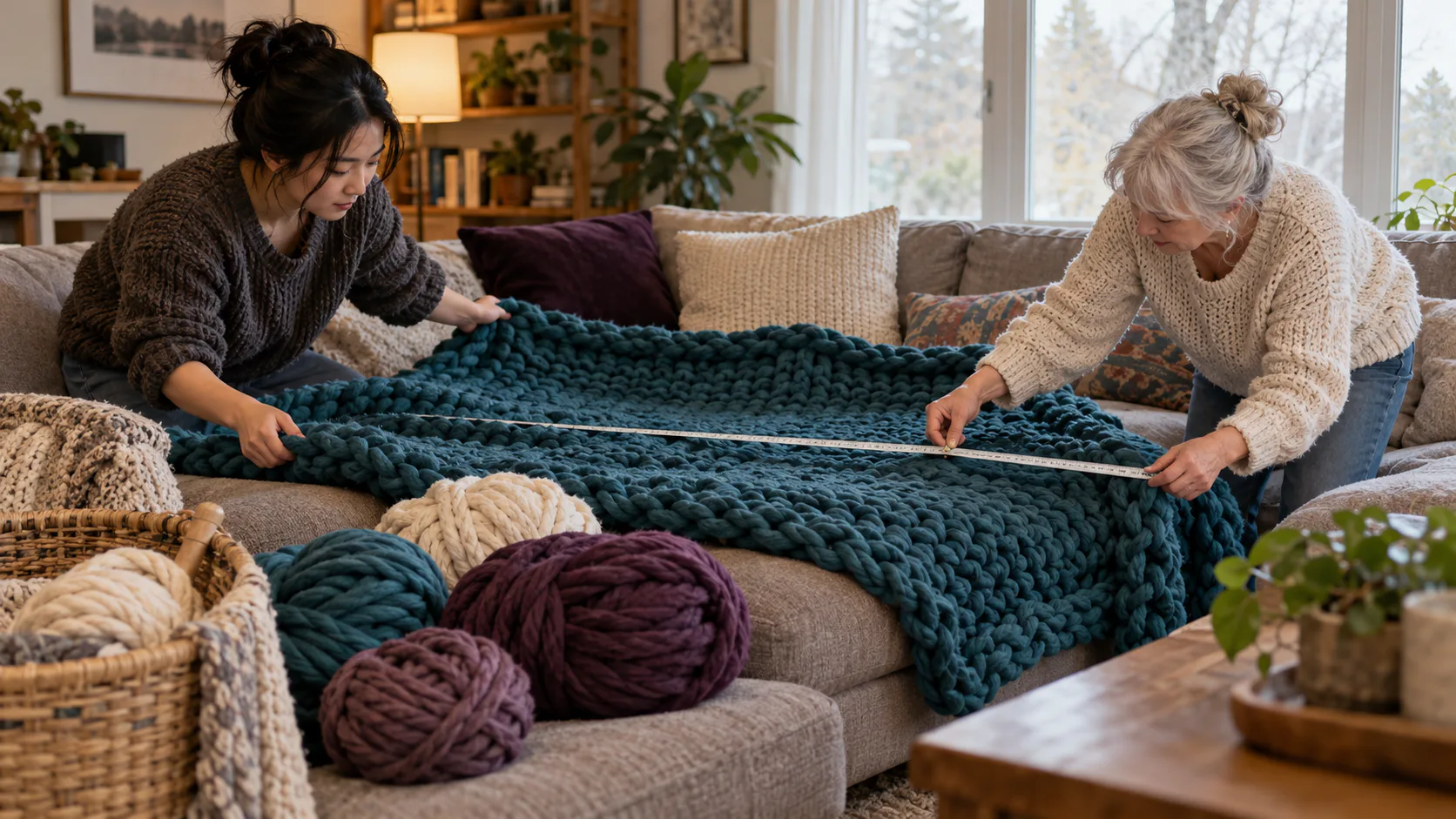
Blanket estimates disagree because a “skein” is only a package. Package length varies by yarn line, and the project estimate may refer to a different blanket type, size, stitch pattern, gauge, or yarn category.
Use two separate inputs:
- the blanket's required total length from its pattern or a clearly labelled planning range;
- the exact yarn's published length per package.
Divide the first by the second and round upward. Keep the source of the project estimate beside the result so an approximate chart does not turn into a promise.
Three kinds of number that look alike
Blanket guides often place yardage and skein counts beside each other, but they answer different questions.
| Number | What it tells you | How to use it |
|---|---|---|
| Pattern requirement | Length for one design and size | Use the figure for the size you plan to make |
| Generic category chart | Broad range for a project type and yarn category | Use for orientation before choosing a pattern |
| Package specification | Length sold in one package of the exact yarn | Use as the divisor in the purchase calculation |
| Package conversion | Whole packages for a chosen total length | Divide total length by package length and round upward |
The package conversion can be exact arithmetic even when the project requirement is an estimate. If the starting yardage changes, the package result changes with it.
Package length changes the raw skein count
Yarnspirations currently publishes Bernat Blanket Extra Thick Perfect Phasing at 65 yd per 600 g package. Bernat Blanket Big is published at 32 yd per 300 g package. Both pages label the yarn as #7 Jumbo and publish the same knitting-gauge line, but the packages hold different amounts.
| Exact yarn line | Package mass | Published package length | Published category |
|---|---|---|---|
| Bernat Blanket Extra Thick Perfect Phasing | 600 g | 65 yd / 59 m | #7 Jumbo |
| Bernat Blanket Big | 300 g | 32 yd / 29 m | #7 Jumbo |
Buying 12 packages of the first line and 12 packages of the second line produces very different totals:
12 × 65 yd = 780 yd
12 × 32 yd = 384 yd
The word “skein” does not normalize those quantities. Compare the length inside the package before comparing the number of packages.
Read a generic chart as a range
Lion Brand's project chart gives broad yardage ranges by project and yarn category. For Jumbo 7, it lists 625 to 750 yd for a baby blanket and 1,375 to 1,625 yd for an afghan. The same page says the guide is not exact and describes it as an estimate.
Those ranges can frame an early budget. They do not establish the requirement for a particular blanket pattern or either Bernat yarn. Keep the labels attached:
| Chart entry | Jumbo 7 planning range |
|---|---|
| Baby blanket | 625 to 750 yd |
| Afghan | 1,375 to 1,625 yd |
The Craft Yarn Council weight system describes Jumbo 7 with a stockinette knitting gauge of six stitches or fewer over four inches. It labels the table as guidelines only and directs readers to follow the gauge in their pattern. A shared category helps describe the yarn, but it does not supply one universal blanket yardage.
Convert both ends of a planning range
When a generic range is all you have, calculate the low and high ends. This shows the possible package spread before you choose a pattern.
Applying Lion Brand's 625-to-750-yard Jumbo baby-blanket range to the two published package lengths gives:
| Exact package | Low-end calculation | High-end calculation | Planning range |
|---|---|---|---|
| 65 yd package | 625 ÷ 65 = 9.62 | 750 ÷ 65 = 11.54 | 10 to 12 packages |
| 32 yd package | 625 ÷ 32 = 19.53 | 750 ÷ 32 = 23.44 | 20 to 24 packages |
Every quotient is rounded upward because yarn is sold in whole packages. These counts answer one conditional question: how many packages contain at least the selected chart length on paper? They do not determine the true requirement of a finished blanket.
The same process applied to the 1,375-to-1,625-yard Jumbo afghan range gives:
| Exact package | Low-end calculation | High-end calculation | Planning range |
|---|---|---|---|
| 65 yd package | 1,375 ÷ 65 = 21.15 | 1,625 ÷ 65 = 25 | 22 to 25 packages |
| 32 yd package | 1,375 ÷ 32 = 42.97 | 1,625 ÷ 32 = 50.78 | 43 to 51 packages |
The wider count for the 32-yard package follows directly from its shorter package length. It is not evidence that the yarn needs more total yardage for the same fabric.
Prefer the pattern when you have one
A pattern narrows the job to one construction and usually lists quantities by finished size. Use that requirement instead of a generic chart when it is available.
Copy the figure for the size you intend to make. Check whether the pattern gives yards, metres, package counts for a named yarn, or more than one of those. If it gives packages of a pattern yarn, first turn them into total length using that exact yarn's package figure. Then divide by the target yarn's package length.
The basic formula is:
target packages = required total length ÷ target package length
Round the final result upward. Keep the unrounded result in your notes because it shows whether the calculation sits just above a whole package or close to the next one.
Use the Skeinote calculator when both exact yarn lines are in the catalogue. It displays the package figures and arithmetic used in the result.
Keep the yarn identity exact
Closely related product names can refer to separate yarns. Bernat Blanket Extra, Bernat Blanket Extra Thick Perfect Phasing, and Bernat Blanket Big are distinct names. A statement written for one line cannot be attached to another because the names look related.
Record the full line name, package mass, package length, and source page together. If a shade family or package format has its own figures, use the entry that matches the product you plan to buy.
A short buying checklist
Before placing an order, write down:
- the blanket's intended finished dimensions;
- the pattern or planning range you are using;
- whether the starting quantity is a single figure or a range;
- the intended stitch pattern and pattern gauge;
- the exact yarn line and package format;
- the published yards or metres in one package;
- the raw division result and rounded whole-package count.
When you begin with a broad range, the result is a broad package range. A pattern, a finished-size choice, and a swatch make the plan more specific.
The useful comparison is never 12 skeins versus 24 skeins by itself. Compare the project length and the length inside each package. Once those inputs are visible, the disagreement becomes understandable arithmetic.